
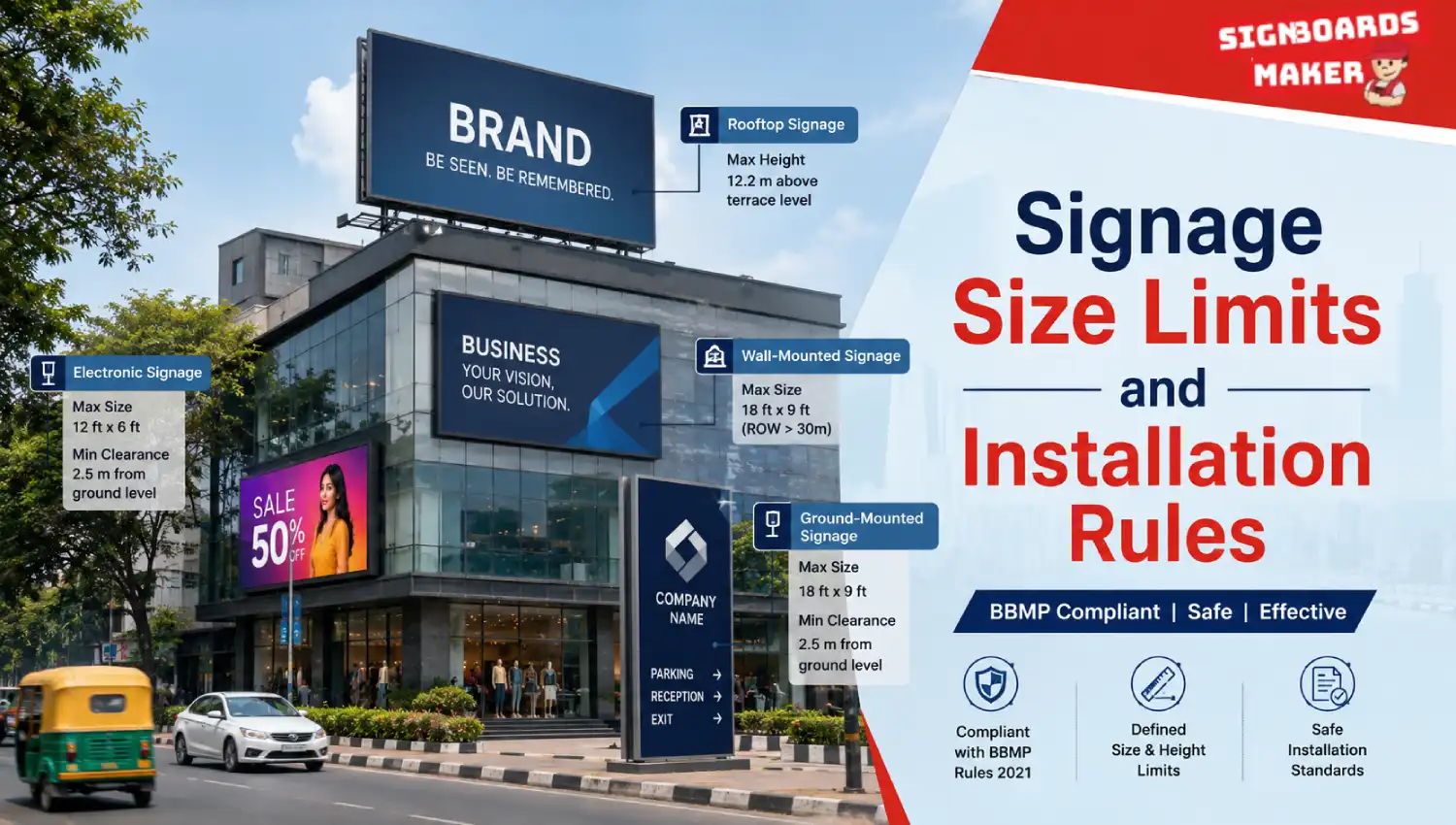
Installing signage boards in Bangalore requires compliance with the BBMP Advertisement Rules, 2021, which specify permitted sizes, height limits, installation clearances, and restricted locations. Whether you are planning a shop sign, electronic signage, or an LED video wall, understanding these regulations helps ensure safety, legal compliance, and hassle-free approvals.
What Are the BBMP Rules for Signage Boards in Bangalore?
The BBMP Advertisement Rules, 2021 regulate the installation, size, location, and maintenance of signage boards across Bengaluru. These rules are intended to improve road safety, reduce visual clutter, protect public spaces, and ensure that every commercial display is structurally safe. Whether you are evaluating reputable companies for digital LED sign board installations or planning any other outdoor signage project, understanding these regulations is essential, as most outdoor advertising installations require prior approval from BBMP before they are erected.
The regulations apply to various forms of outdoor displays, including commercial signboards, electronic signage, LED displays, hoardings, banners, building wrap advertisements, and digital advertising devices. The rules also define where signage boards can be installed, maximum dimensions, height restrictions, required clearances, and locations where advertisements are prohibited.
For businesses planning new branding or advertising, understanding these requirements helps avoid penalties, unauthorized installations, and costly modifications after installation.
Types of Signage Boards Covered Under BBMP Regulations
BBMP recognizes several categories of outdoor advertising and display structures. Each type has its own installation requirements, size limitations, and approval process depending on its location and purpose.
1. Wall-Mounted Signage Boards
Wall-mounted signage boards are installed directly onto the exterior walls or façades of commercial buildings. These are commonly used for retail stores, offices, restaurants, hospitals, educational institutions, and commercial complexes. Their installation must comply with BBMP’s structural and location requirements.
2. Rooftop Signage Boards
Rooftop signage boards are fixed on the terrace or roof of a building to maximize visibility from surrounding roads. BBMP specifies limits on the overall height of rooftop installations and requires proper structural stability to ensure public safety.
3. Ground-Mounted Signage Boards
Ground-mounted signage boards are supported by independent structures rather than attached to buildings. These include pylon signs, monument signs, and freestanding commercial displays installed within private properties. Their dimensions, height, and ground clearance must comply with the prescribed standards.
4. Electronic Signage and LED Video Wall Displays
Electronic signage and LED video wall displays use LED, LCD, or similar digital technologies to present advertising and informational content. BBMP permits such displays subject to specific conditions relating to installation, display behaviour, brightness, and road safety to minimize driver distraction.
5. Hoardings and Building Wrap Advertisements
Hoardings are large-format advertising structures installed either on the ground, rooftops, or building walls. Building wrap advertisements cover part or all of a building façade using approved display materials, while electronic building wraps use digital display technology on eligible buildings. Both categories are governed by BBMP’s approval process and technical standards.
Standard Size Limits for Signage Boards
| Type of Signage Board | Maximum Display Size (W × H) | Applicable Installation Limit | Minimum Ground Clearance |
|---|---|---|---|
| Wall-Mounted Signage Boards (ROW below 30 m) | 12 ft × 6 ft | Subject to BBMP approval and applicable installation rules | Not Specified |
| Wall-Mounted Signage Boards (ROW above 30 m) | 18 ft × 9 ft | Subject to BBMP approval and applicable installation rules | Not Specified |
| Rooftop Signage Boards | 12 ft × 6 ft (ROW < 30 m) / 18 ft × 9 ft (ROW ≥ 30 m) | Maximum 12.2 m above the terrace level | Not Applicable |
| Trivision Signage Boards | 12 ft × 6 ft | Subject to BBMP approval | Not Specified |
| Electronic Signage / LED Video Wall / LCD Display | 12 ft × 6 ft | Must comply with BBMP digital display regulations | 2.5 m (if ground-mounted) |
| Ground-Mounted Billboards | 18 ft × 9 ft | Maximum 25 m above road level | 2.5 m |
Notes
- Maximum standard display size permitted under the rules is 18 ft × 9 ft.
- Larger display panels are not permitted.
- A minimum setback of 1.5 m from the edge of the Right of Way (ROW) should be maintained.
- Signage should not be installed within 25 m of a road junction or stop line.
- Sandwich (back-to-back) and V-shaped hoardings are permitted.
- Supporting structures should remain within the approved structural dimensions.
Height, Clearance and Installation Requirements
Proper installation of signage boards is just as important as selecting the correct size. BBMP has laid down specific requirements to ensure signboards do not obstruct traffic visibility, endanger pedestrians, or affect surrounding infrastructure. Businesses planning to install commercial signage, electronic signage, or an LED video wall should ensure these standards are met before applying for approval.
1. Maximum Height Limits
BBMP specifies different height limits depending on the type of signage board. Ground-mounted billboards can extend up to 25 metres from road level, while rooftop signage should not exceed 12.2 metres above the terrace level. These limits help maintain structural safety and preserve the city’s skyline.
2. Minimum Ground Clearance
Where applicable, the bottom of a signage board should maintain adequate clearance above the ground. Ground-mounted structures generally require a minimum clearance of 2.5 metres, allowing safe pedestrian movement and ensuring the sign does not obstruct vehicles or public infrastructure.
3. Distance from Roads and Junctions
To improve road safety, BBMP does not permit signage boards near traffic intersections. Commercial signboards should be installed at least 25 metres away from the stop line of road junctions and maintain a minimum setback of 1.5 metres beyond the edge of the Right of Way (ROW) wherever applicable.
4. Structural Safety Requirements
Every commercial signage installation must be supported by a structurally sound framework approved by a qualified engineer. During the permission process, BBMP also requires supporting documents such as structural stability certificates, topographical sketches, and property owner consent wherever applicable. Any structure exceeding the approved dimensions may be treated as a violation of the permit conditions.
Where Signage Boards Are Not Allowed in Bangalore
BBMP prohibits the installation of signage boards in several sensitive locations to safeguard public safety, preserve heritage areas, and prevent visual clutter. Businesses should verify the proposed installation site before investing in any outdoor signage project.
1. Religious Places
Signage boards are not permitted within 50 metres of religious places and within 100 metres on roads leading exclusively to temples, mosques, churches, and gurudwaras, subject to the conditions specified by BBMP.
2. Flyovers and Bridges
Commercial signage is restricted near flyovers, railway overbridges, elevated corridors, communication towers, and similar structures. These restrictions help prevent driver distraction and maintain public safety.
3. Heritage Zones
No signage boards or outdoor advertisements are permitted on heritage buildings, archaeological structures, or within notified heritage areas. These regulations help preserve Bengaluru’s cultural and architectural identity.
4. Parks and Water Bodies
BBMP prohibits outdoor advertisements in public parks, gardens, forests, lakes, riverbeds, and other protected environmental areas to preserve the natural landscape.
5. Traffic Junctions and Footpaths
Signage boards are not allowed within 25 metres of traffic junctions or stop lines, on traffic islands, or on footpaths. Installations that obstruct pedestrian movement or reduce driver visibility are also prohibited.
Electronic Signage and LED Video Wall Installation Rules
Electronic signage and LED video wall displays are permitted under the BBMP Advertisement Rules, 2021, provided they are installed in approved locations and comply with the prescribed technical and safety standards. Since digital displays are more likely to attract the attention of motorists, BBMP has introduced additional restrictions to minimise distractions and improve road safety.
1. Display Restrictions
Electronic signage should not interfere with traffic signals, resemble traffic lights, or obstruct the visibility of road signs. Displays that create confusion for motorists or affect public safety may be refused permission by BBMP.
2. Image Change Timing
BBMP does not permit moving videos on digital advertising displays. LED video walls should display static images only, and the content should change only after a minimum interval of 10 seconds. This helps reduce driver distraction while maintaining the effectiveness of digital advertising.
3. Brightness and Illumination Rules
Illuminated signage should not create glare or discomfort for road users. Neon signs in residential areas should not flicker and should be switched off by 10:00 PM. Illuminated hoardings should not remain operational beyond 11:00 PM, except where otherwise permitted by BBMP.
Important BBMP Installation Guidelines
- Obtain BBMP approval before installing commercial signage boards.
- Use a licensed or registered advertising agency wherever applicable.
- Install signage only after obtaining the property owner’s No Objection Certificate (NOC).
- Ensure the supporting structure is certified by a qualified engineer.
- Follow the prescribed size, height, and ground clearance limits.
- Maintain the required setback from roads, junctions, and restricted zones.
- Avoid installing signage on footpaths, traffic islands, heritage buildings, parks, or lakes.
- Electronic signage and LED video walls should display static content with image changes only after 10 seconds.
- Renew the permission before its validity expires if the signage continues to remain in place.
- Ensure the installed signage matches the approved drawings and dimensions.
Common Mistakes Businesses Make While Installing Signage Boards
- Installing signage without obtaining BBMP approval.
- Ignoring prescribed size and height restrictions.
- Installing boards too close to road junctions or traffic signals.
- Failing to obtain the property owner’s NOC.
- Using unsupported or unsafe structural frameworks.
- Displaying moving video advertisements on LED video walls.
- Extending the supporting structure beyond the approved dimensions.
- Installing signage in prohibited locations such as footpaths, parks, or heritage zones.
- Failing to renew permissions before expiry.
- Assuming every shop sign or electronic signage installation is exempt from approval.
Why Following BBMP Signage Board Rules Matters
Following BBMP regulations helps businesses install signage boards that are safe, compliant, and professionally executed. Compliance reduces the risk of penalties, removal notices, and unnecessary modification costs while ensuring better visibility without compromising public safety. It also helps businesses maintain a professional brand presence by installing electronic signage and LED video wall displays in accordance with approved engineering and municipal standards.
Frequently Asked Questions About BBMP Signage Boards
1. Do all signage boards require BBMP approval?
No. Certain business identification signs and name boards are exempt, while most commercial outdoor advertisements require prior permission from BBMP.
2. Are LED video walls allowed in Bangalore?
Yes. LED video walls are permitted, provided they comply with BBMP’s size, installation, display, and safety requirements.
3. Can digital displays show videos?
No. BBMP allows only static images, and the display should change only after a minimum of 10 seconds.
4. How long is a BBMP signage permission valid?
A permission is generally valid for up to three years, after which it must be renewed.
5. What happens if a signage board violates BBMP rules?
BBMP may remove unauthorised signage, recover removal charges, impose penalties, and initiate further action against the advertiser or agency for continued violations.